If there is one remark I hear often at events and when talking to people about conservation and our natural resources, it usually revolves around, “I wish I had more time (or knowledge) to help or be involved.”
I totally get that feeling. We all are spread so thin, trying to balance work, life, family, activities, and more. Yet, there are actually a lot of opportunities out there for people to aid in conservation and natural resource work that doesn’t take a huge effort or time commitment (and can be a great opportunity to get kids involved!). This week’s blog is dedicated to a list of some of my favorite ‘citizen scientist’ initiatives where small efforts from many add up to a significant impact.
Community Collaborative Rain, Hail and Snow Network – “CoCoRaHS”
Frequency of effort: Daily, year-round
Time required: 1-2 minutes (but as close as the same time of day as possible)
Reporting: Online
Cost: $35-40 to buy official gauge
Training: Self-pace online course
First off, no, CoCoRaHS has nothing to do with Cocomelon. Just wanted to clarify that for all the parents of young children out there.
CoCoRaHS is a non-profit, community-based network of volunteers that provide daily precipitation (rain, hail, snow) observations from across the nation. Originating in 1998 at Colorado State University in response to a large flood event, this network of volunteers provides daily data that is then utilized by weather forecasters, hydrologists, researchers, water managers, climatologists, agronomists, engineers, and even insurers to form reports, warnings, and predictions in real time. We all know how variable weather can be over a short distance, so having as many data points on the ground as possible is invaluable.

To become a volunteer, you join online, providing the location of where you will install the official precipitation gauge and telling what time of day you intend to make your daily observation. There are online training modules on how to take those spot measurements and how to report, but after that, you’re taking 2 minutes out of your day to provide some really valuable continuous data.
Adopt-a-Drain
Frequency of effort: Monthly (maybe twice a month during winter melt and leaf fall in the autumn months)
Time required: 15-30 minutes
Reporting: Online
Cost: None,
Training: None
As we build on landscapes with impervious buildings, roads, parking lots, sidewalks, etc., rain can no longer infiltrate into the ground. To adapt, we build storm sewer systems, collecting that runoff via a integrated network of gutters, curbs, storm drains, and pipes until that water is delivered directly to nearby lakes, rivers, streams, and/or wetlands.
Problem is, those storm drains not only gather water, but any pollutants or debris carried along by that water. Those pollutants include natural materials like leaves and dirt, which contain phosphorus that can spawn massive algal blooms in our waterways. One pound of phosphorus (roughly 5 bags of fall leaves) can grow over 500 pounds of algae. Yikes.
The Adopt-a-Drain program, initiated in 2014 by Hamline University in St. Paul, relies on volunteers ‘adopting’ local storm drains and committing to keeping them clean, especially in the spring and fall when you get large influxes of seeds and leaves. To date, over 744,000 lbs of debris have been collected from 25,446 adopted drains by 14,650 volunteers.

I love this concept because it takes a simple action by one person and shows how together, those small actions add up to a really big impact.
MPCA Water Monitoring Volunteer Program
Frequency of effort: Twice a month during the summer months
Time required: 15-30 minutes
Reporting: Online
Cost: None – equipment is provided to you
Training: Online
Are you a Minnesotan that enjoys being around our lakes and rivers in the summer? I’m going to take a wild guess and say yes. By joining the Minnesota Pollution Control Agency Volunteer Water Monitoring network, you can help gather critically important water clarity data on Minnesota lakes and rivers.
During the summer, volunteers measure water clarity (how clear the water is) using a provided Secchi disk or tube at designated locations. They record their observations, and submit the data at the end of the monitoring season. The MPCA uses the data to help make decisions about watershed protection and restoration efforts.
Salt Watch – Izaak Walton League
Frequency of effort: 1 kit contains 4 test strips
Time required: 5-10 minutes per strip
Reporting: Online
Cost: None, although you can sponsor more test kits ($10 per kit)
Training: With kit materials
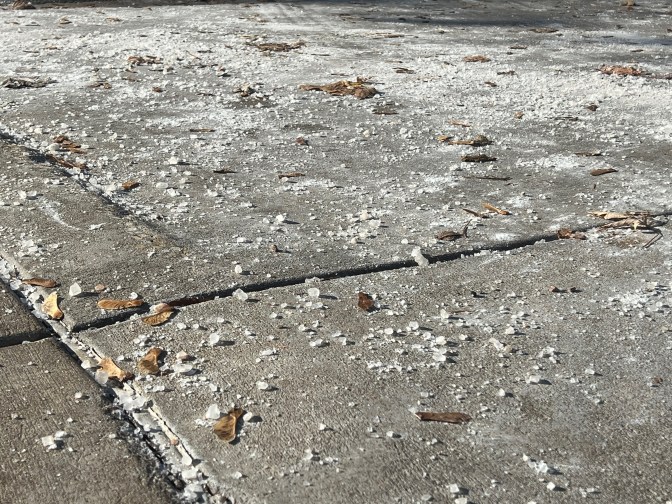
In our winters (though less so for this season!), we use road salt to melt ice and keep our roads and sidewalks safe for drivers and pedestrians. Unfortunately, that salt accumulates in our environment, and poses a threat to our waterways, wildlife, and drinking water. Currently, Minnesota has 67 lakes and streams characterized as impaired for chloride, with many more approaching that threshold.
If you are concerned about chloride levels in your local lake or stream, Salt Watch is a great option where you can learn more about conditions locally while also submitting data into a national database. After signing a Salt Watch pledge, you will be sent a free testing kit with four test strips to use in a local lake or stream. You can use the test strips at any time, but the kit has some recommendations for when to collect data to establish baselines and when you would expect to see increased chloride levels.
And really, there are so many more opportunities out there…
It really all depends on your interests – whether it be wildlife, invasive species, lake levels, bumblebees, and so much more. They will have varying levels of effort and training needed, but most will likely have a way for you to keep in the know, even if you feel you can’t commit right now.
Here are a few more good ones!
- Purple Loosestrife Biocontrol Project: https://wildriversconservancy.org/get-involved/biocontrolproject/
- Aquatic Invasive Species (AIS) Detectors Program: https://maisrc.umn.edu/ais-detectors
- Minnesota Bumble Bee Atlas: https://mnbumblebeeatlas.umn.edu
- The Monarch Larva Monitoring Project: https://www.citizenscience.gov/monitor-monarchs/#
- Marine Debris Tracker (help collect and keep plastics from the Mississippi River!): https://debristracker.org/
- Bluebird Recovery Program of Minnesota: https://bbrp.org
- Lake Level Minnesota: https://www.dnr.state.mn.us/…/waterlevels/lakes/index.html
- Starry Skies North: https://starryskiesnorth.org
- City Nature Challenge: https://citizenscience.umn.edu/upcoming-events/city-nature-challenge

 knickpoints