Let it be said: working in the conservation field is not an easy endeavor. In fact, my husband regularly hears about what I’m working on, shakes his head, and says, “Trying to convince people that this is important and worth changing their behavior for is a tough sell.”
I get it. And it’s true.
“Selling” conservation may mean shaking people out of habits and perceptions they’ve established over years (or even generations!) of experience. It’s about finding the hooks of what people care about, and linking it to practices (and cost-share!) that help protect and restore our water and natural resources. In many cases, it really does involve a mindful and significant commitment on behalf of the landowner, which means we need to do the long work of building relationships and trust with that landowner. This is not an easy or fast process.
Thus, when we do find people or entities that are ready to adopt conservation practices, whether because it benefits them or because they believe in the cause of taking care of our natural resources, it deserves some recognition.
Every year, soil and water conservation districts throughout the state select an individual or entity they’ve worked with as their “Outstanding Conservationist.” This individual(s) or organization may have started working with the SWCD years ago or just that year, but it’s a way to showcase landowners who have taken a significant step or many steps into a conservation journey.
So without further ado, here’s a bit about the 2023 Outstanding Conservationists in our corner of east-central Minnesota.
Pine SWCD Outstanding Conservationist AND 2023 Minnesota Outstanding Conservationist: Randy and Pam Hinze
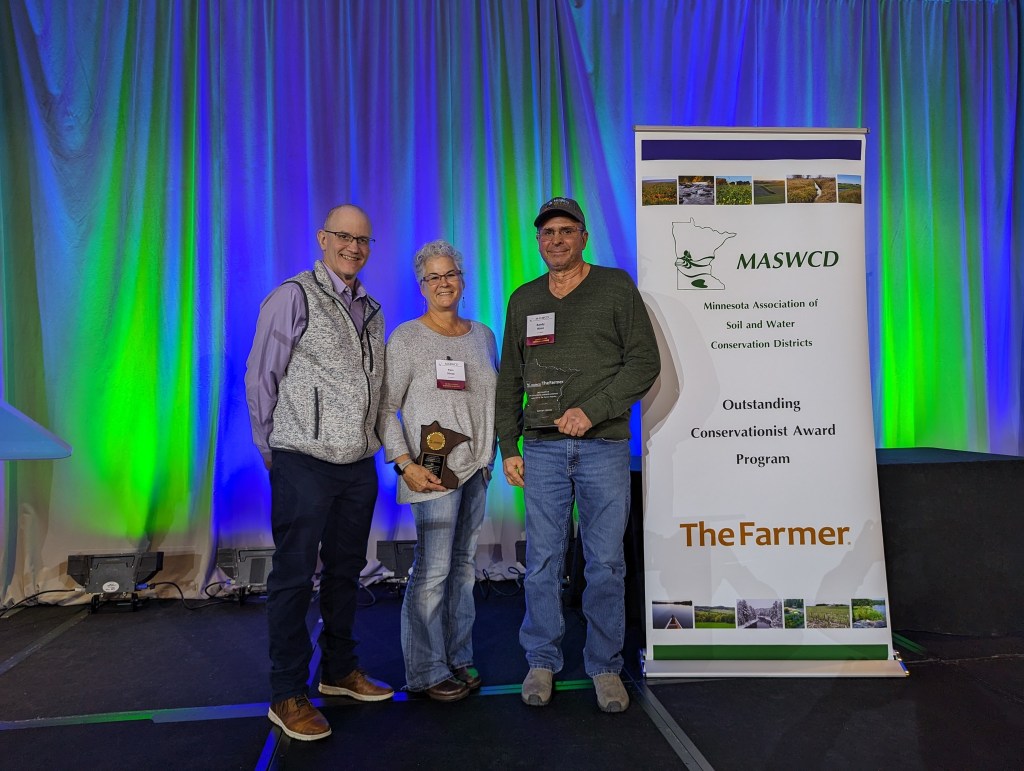
As you drive along Hwy 61 south of Pine City, you’ll notice rolling hills of cropland that extend as far as the eye can see. Driving past farmsteads, you might notice a brown wood sign with an image of a green and yellow tractor up top that reads, “Hinze Farms, Established 1913.”
Randy Hinze and his wife Pam are third-generation farmers on the land, which started as a dairy farm operation under Randy’s grandfather in 1913. The operation has evolved with the decades, including an expansion from 130 acres to 400 acres in 1986 as their crop operation grew. In the last couple years, the family decided to transition fully from dairy to small grains and row crops, complemented by a small herd of beef cattle for direct marketing.
Randy’s current conservation portfolio is extensive, including no-till farming, planting cover crops, installing water and sediment control basins, building fences to keep his cows out of nearby Rock Lake, and planting pollinator habitat. However, the catalyst for starting his conservation journey back in the early 2000s boiled down to a very practical reason: time. When his dad retired from helping run the operation, there was just too much work for one person. He needed to streamline his operation, and when he heard about how no-till farming would mean less time in a tractor and less money on fuel and equipment maintenance, it intrigued him. He bought a no-till planter in 2005, and over the next decade, transitioned his farm fully to no-till – even eventually selling his tillage equipment.
A common refrain in conservation circles is that conservation is a slippery slope – you try one thing, and then that leads you wanting to try another. The Hinze story is exactly that – a willingness to try no-till farming opened the door for exploring and adopting other conservation management practices, and Randy and Pam haven’t looked back since. It is a state distinction well-deserved!
Isanti SWCD 2023 Outstanding Conservationist: Keith Stamm

One of the most impactful ways to ‘spread’ conservation is to find an early adopter – somebody willing to try something out and then is willing to share what happened with their neighbors. Keith Stamm fits that bill.
For over a decade, Keith has (along with his wife and their loyal, beloved Corgi) have been implementing practices that help build soil health on their operation. They no-till a majority portion of their farm, which minimizes soil disturbance, and employ a diverse crop rotation, including corn, soybeans, small grains, and occasionally hay and alfalfa. They also plant cover crops on their grain fields, and Keith’s current interest is researching and trying different cover crop mixtures to see which thrive most in the area.
Keith also is interested in sharing ideas and hearing about what others are doing. This past September, he hosted a soil health field day at his farm so other farmers could visit his cover crop demonstration plot and ask questions. He has also agreed to help initiate a new farmer-led group in partnership with the Isanti SWCD.
Chisago SWCD 2023 Outstanding Conservationist: May Family Farms
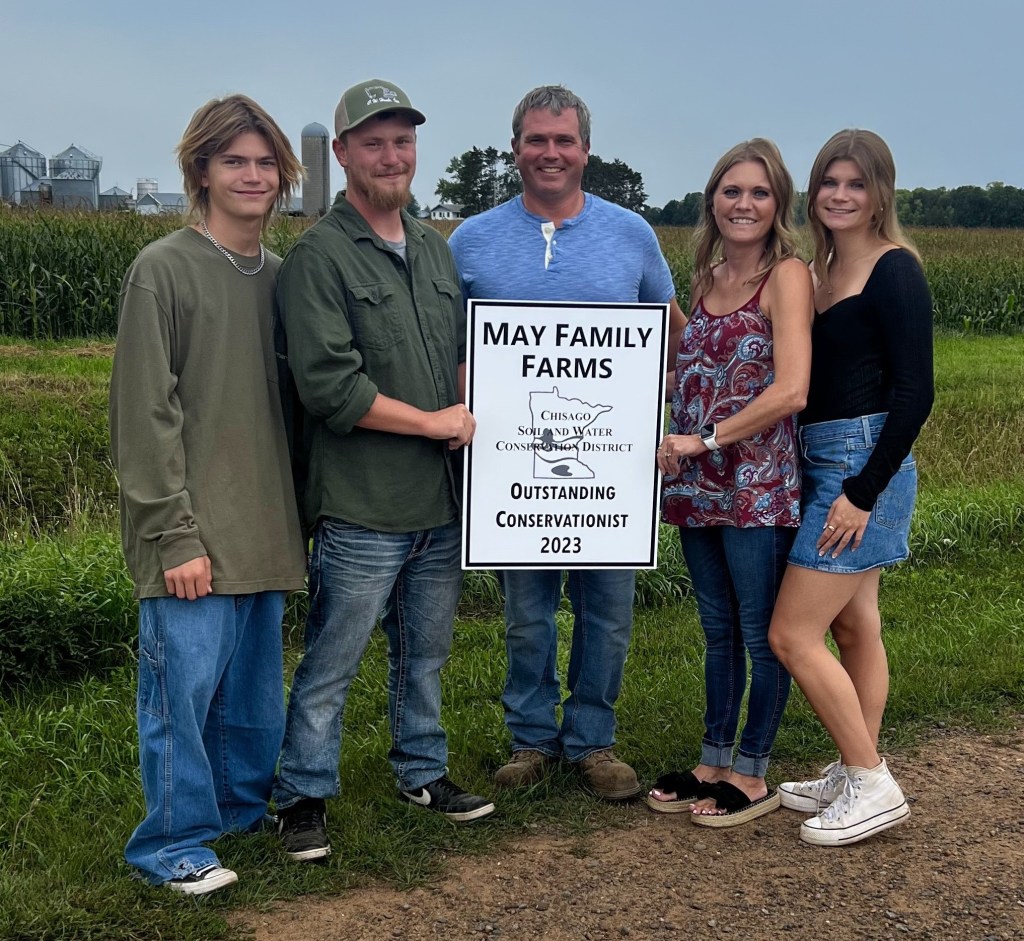
I had the privilege of conducting an interview with Jason and Becky May back in 2022 as part of a push to feature local producers using conservation practices on their farms. The part of the interview that stuck out the most to me was Jason’s very practical advice to any farmer interested in trying a new management practice in their operation. “Start slow. You don’t have to transform the whole farm all at once. Just try something on a few acres. See how it goes. I bet it might make you want to try more.”
That’s certainly been the case for the May Family Farm, which includes approximately 1,500 acres in corn and soybeans near Rush City. Back in 2001, Jason first contacted the Chisago SWCD about installing a farmstead shelterbelt and field windbreak using the Continuous Conservation Reserve program. The project would be a first of many over the next 20+ years, including watching Jason switching his operation to no-till and strip till to reduce soil erosion and build soil health. This past year he also utilized available funding to try cover crops on a portion of his acres.
In June 2015, when the Minnesota “Buffer Law” came into effect, Jason was among the first farmers to reach out to the Chisago SWCD as the farm has several miles along Chisago County Public Ditch #6. The Chisago SWCD formulated a comprehensive farm plan to help him comply with the regulations, incorporating vegetative filter strips and several other alternative practices. Going beyond the public ditch, the also Mays installed buffers along most of their private ditches to capture and treat runoff from their farm.
This year, the Mays’ farm was awarded certification in the Minnesota Ag Water Quality Certification Program, reflective of all of their efforts in the past two decades to implement conservation on their lands. As summed up by Craig Mell, District Manager of the Chisago SWCD, “They have been worthy of Outstanding Conservationist the past couple years, but with the cumulation of all they’ve done and now getting Ag Water Quality certified, it was no question for our Board of Supervisors – May Family Farms are the epitome of Outstanding Conservationists and people should know it,”
WCD 2023 Outstanding Conservationist: Keene Farms, LLC
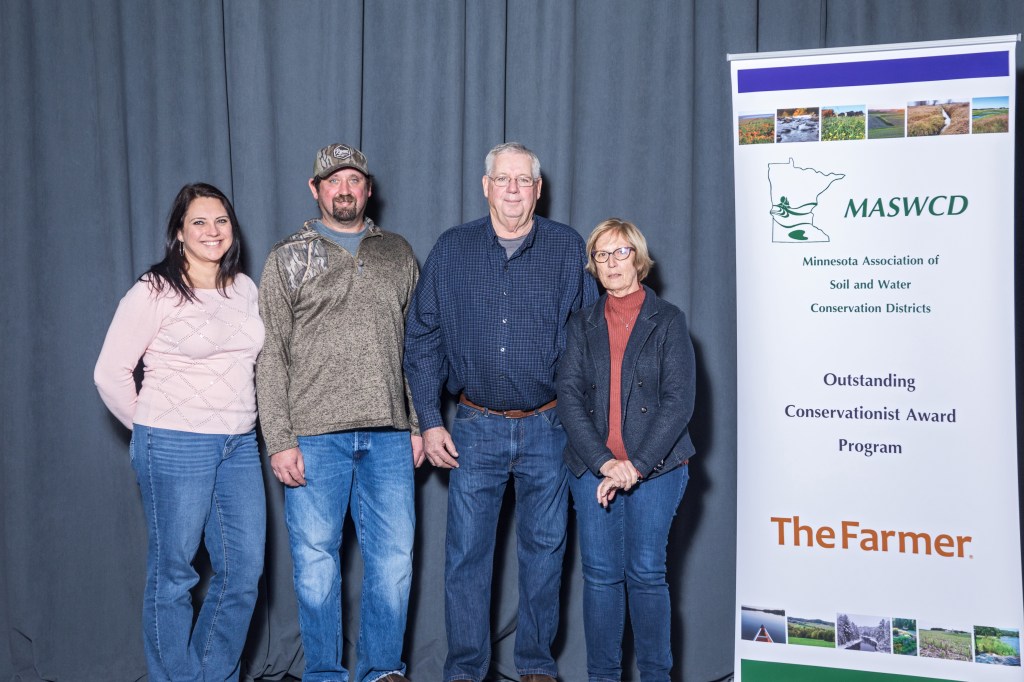
It’s one thing to implement conservation practices to protect nearby lakes and streams, and another to actively monitor the nearby lakes and streams to have a fuller understanding of how those water bodies are doing. The Keene family, located in Denmark Township, is doing just that.
Keene Farms started in 1959 with a 40-acre parcel, and has since grown under the partnership of Jeff Keene and his son, Nicholas. Their fields contain shoreline of O’Connors Lake, a closed basin lake that collects drainage from approximately 6,000 acres of agricultural and rural residential lands. To better understand pollution inputs to the lake, the Keene’s joined Metropolitan Council’s Citizen Assisted Monitoring Program (CAMP) in 2005 and have been assisting the Washington Conservation District in their monitoring efforts ever since.
Keene Farms has also made significant strides in adopting conservation practices into their farming operation. Just this past year, the family implemented multi-year cover crops, no-till, and hay plantings in a vulnerable groundwater area to protect groundwater as a drinking water source from nitrate leaching. They’ve partnered with the Washington Conservation District and South Washington Watershed District to help fund those projects. They also actively encourage their neighbors to try new agricultural best management practices, resulting in additional implementation of practices on hundreds of acres in southern Washington County.
Many congratulations to all the awardees!

 knickpoints