At the end of October, I went to pick up my daughters from school. It was a blustery cold day – the trees were quickly losing their fall leaves and you could feel the frigid bite of the air on your nose and cheeks. This was the first significant cold snap of the fall, and as always, it reminds you that Minnesota winter is just over the horizon.
As I walked up the sidewalk to the school with my head slightly bowed to protect my nose in my scarf, I saw it.
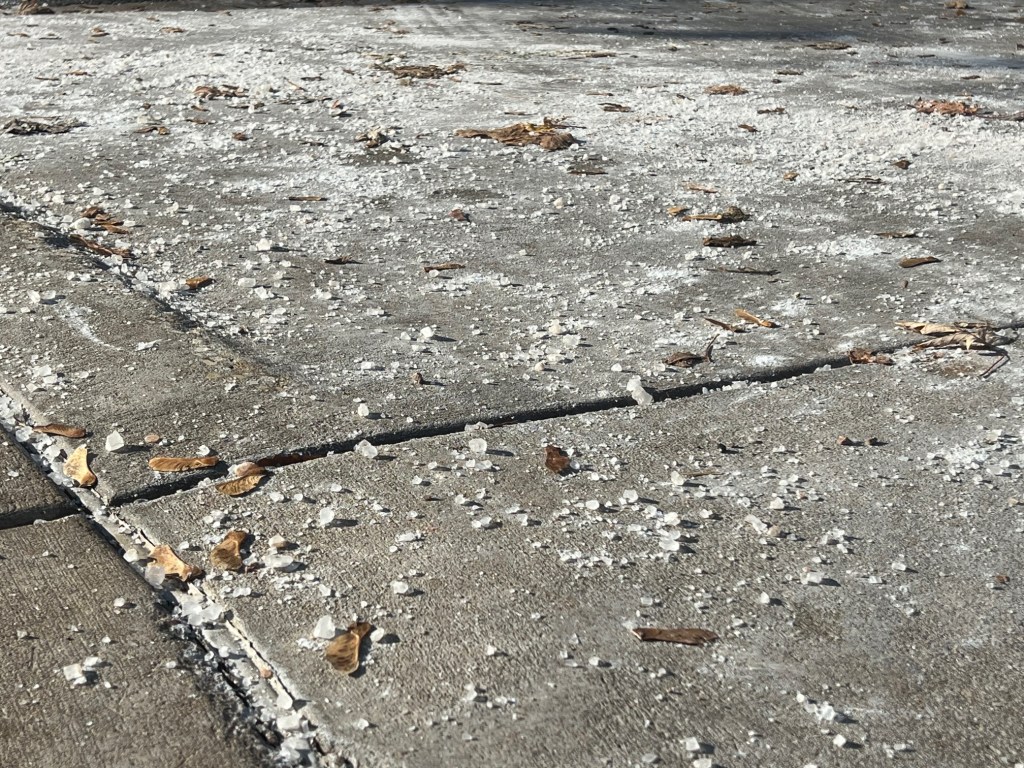
Road salt. Big fat chunks and piles were all over one of the driveways that leads up to the school.
I inwardly screamed. Those crystals sat there waiting to be knocked aside into the street and to a nearby storm drain. The crystals would dissolve, and that resulting chloride load would be directly delivered to the St. Croix River.
The first cold wet of the season is always a tricky one – if those temperatures start to dip and there is rain or freezing rain or snow in the forecast, you can bet that ice and liability are on the minds of any school, business, or public works staff.
When in doubt, salting roads, sidewalks, and parking lots is our default. Putting it out there, even if it’s not the best time to put it out there, is considered being safe rather than sorry. Nobody wants the bad optics and potential lawsuit of a slip and fall.
Yet, every year, we hear the drawbacks of our salt addiction. Rock salt can induce corrosive damage to automobiles, trucks, bridges, and roads, leading to an annual repair cost of around $5 billion in the United States alone. Excess road salt in roadside areas poses a threat to roadside vegetation and wildlife. Additionally, the salt-laden roads attract animals such as deer and moose, drawn to the salt for licking, thereby elevating the risk of accidents and roadkill.
And then there is the impact on our water resources. One teaspoon of salt permanently pollutes five gallons of water. In the last two decades, we’ve observed steep increases in chloride pollution in wells that supply our drinking water as well as in our lakes, rivers, and streams. There are now 54 water bodies on the Minnesota impaired waters list that exceed the chloride standard designed to protect fish and other aquatic life. Another 75 water bodies are at high-risk of being listed. Much of the impact is documented in the Twin Cities metro, but as more data is being collected in greater Minnesota, the chloride is there.
It’s a problem, and a very very tricky balance for those who regularly take on the responsibility of balancing public safety, protecting infrastructure, and reducing environmental impacts during a Minnesota winter.
Yesterday, the Lower St. Croix Watershed Partnership, in collaboration with the Chisago Soil and Water Conservation District and Isanti Soil and Water Conservation District, hosted a MPCA Smart Salting for Roads Certification Training in North Branch. Forty participants, including representatives from counties, cities, townships, and private companies, convened in a classroom. Their objective was to acquire the latest best practices for winter ice management and to explore how to integrate these practices into their operations. Ideally, the goal is to maintain a level of service that meets customer expectations while simultaneously reducing the use of salt.

What immediately started to become clear as the knowledgeable instructors started to dig in, is that there are a lot of factors that go into how you manage ice. Are your customers expecting bare pavement on all the roads (will require more salt to maintain) or are they content with a non-bare pavement strategy? How long will it take to run your proposed route and can you staff it? What equipment do you have to physically remove snow/ice? What types of materials do you use to melt ice or help with road traction? How does your equipment distribute that material and what’s the application rate? How do you calibrate it?
And then of course, let’s not forget the trying to manage the biggest unknown – the weather. Most organizations have to decide how much salt they want to stockpile for the coming winter well before one snowflake hits the ground. One attendee noted that last year, during Minnesota’s 3rd snowiest winter, their salt pile and budget was blown by the end of January.
Temperature plays a huge factor. Granular sodium chloride, which is the road salt we’re all most familiar with, isn’t effective at temperatures less than 15 degrees Fahrenheit, so if you have times of prolonged subzero temperatures, that sodium chloride will do nothing for you. You could use liquid magnesium chloride or calcium chloride instead – those work well at -10 and -20 degrees F – but beware. If you overapply it or temperatures warm too much, it can actually become as slippery as ice. And we haven’t even begun talking about monitoring pavement temperatures, which lag behind air temperature, which can fully change what treatment will be the most effective.
Oy vey. So many factors in play. And while there are many opportunities to help organizations improve their operations and reduce their salt use, the issue of public perception kept popping up. We Minnesotans expect to continue with our daily lives during the winter. We still need to get to work, busses need to take kids to school, drivers need to make deliveries – we expect to see a lot of bare pavement. We want to see our ice fighters out there plowing and salting so we can continue doing what we need to do.
That demand and perception has such a high cost – structurally and environmentally. Because we expect to see salt, our ice fighters will put it down so we feel safe, even if that salt isn’t actually doing that good of a job.
Case in point: After wrapping up the training, I helped one of the instructors load extra materials up in his car. As he shut the trunk, both of us looked down to see a random pile of road salt below his car on a completely dry parking lot. Oh, the irony.

The effort to shift public perception of salt is well underway, and there is a growing number of people who are very concerned about chloride pollution and the impact it’s having on our drinking water wells and waterways. Who knows, maybe a turn against salt might encourage us to change our hustle bustle winter culture – we can drive more slowly, take the time to shovel, and not freak out if we don’t see parking lots covered in salt crystals.
In the meantime, we have 40 newly certified Smart Salters that hopefully will take some of the strategies they heard about today and reduce their salt use in their communities this coming winter. If they can reduce salt use even by 50 pounds, they are potentially saving upwards of 10,000 gallons of water from chloride pollution. That’s a pretty decent impact.

 knickpoints