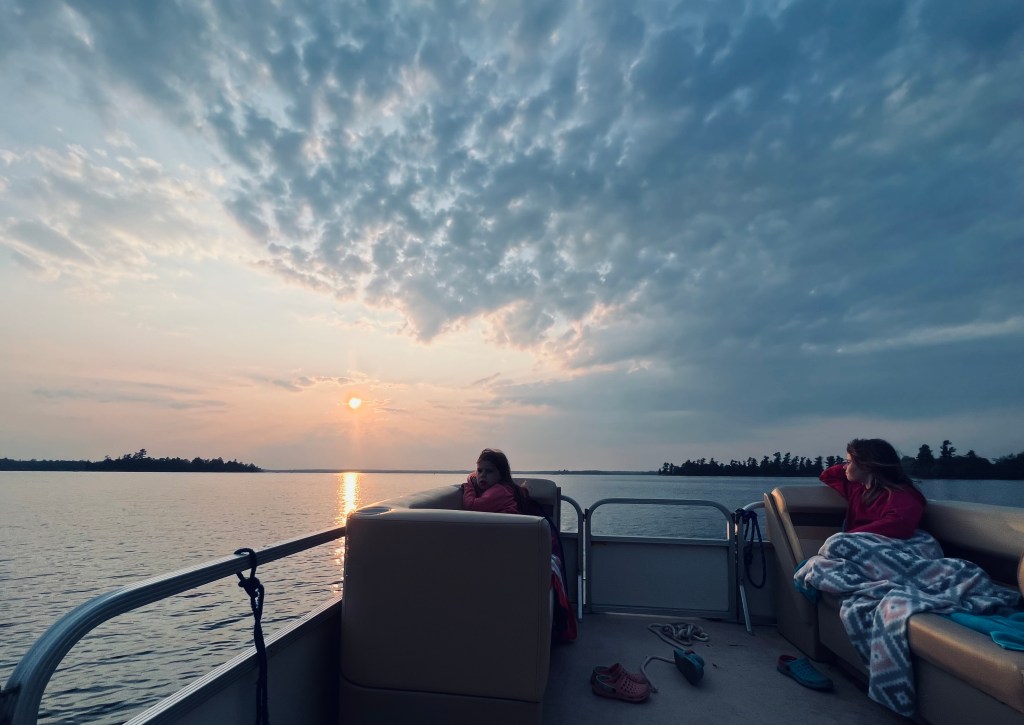
When I looked to the horizon, I couldn’t see where the sky ended and the water began. I heard the distant roar of a boat engine behind us, but the water in front of us was smooth glass interrupted only by small wind ripples. As the sun continued to slide downward, softly closing out the day, all was quiet. I looked to the front of our rented pontoon to see my two daughters curled up in blankets, chins lifted to the sky, silently caught in the spell of calm beauty around us. I sighed quietly, letting my heart fill.
“This. I want to remember this. I want them to remember this,” I thought. And of course, as people this day and age do, I quickly and subtly snapped a photo of the moment.
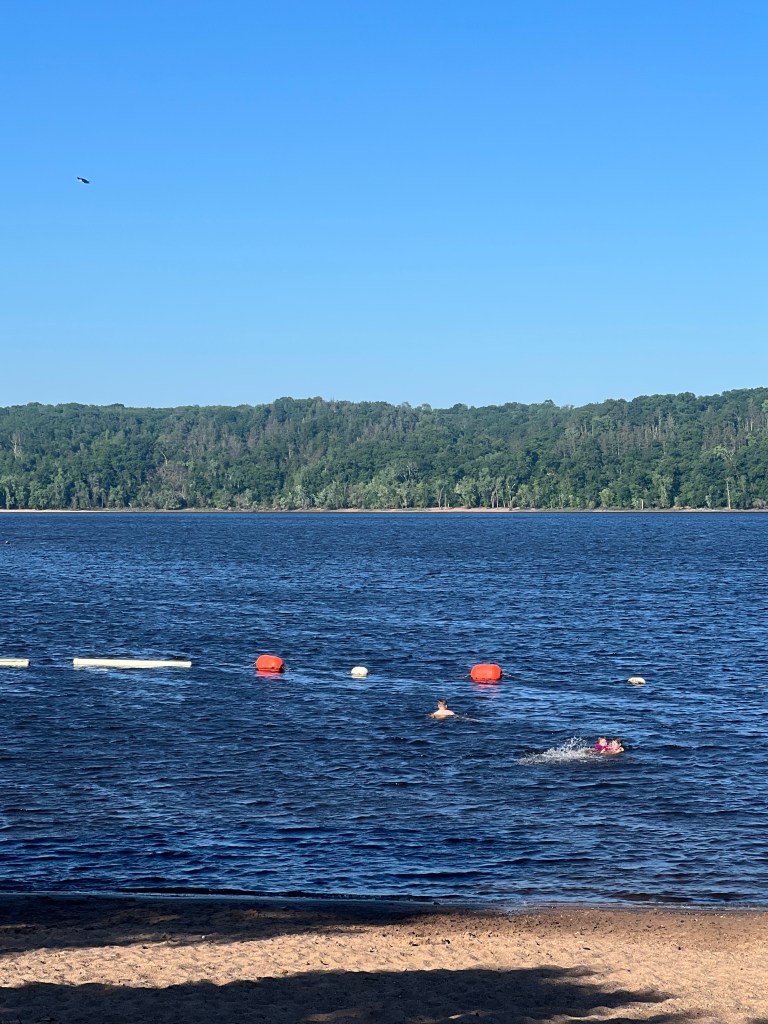
Fast forward three days later. After getting home from our camping trip up north, the girls and I were sticky with sweat from helping Dad unload our camper. Instead of turning on our sprinklers, however, we decided to head to our nearby St. Croix River swimming beach at Lakeside Park in Bayport to cool off. We arrived to find it almost abandoned – the heat of the day had passed and most families had moved upland to the playground and picnic tables. My girls eagerly plowed right into the water. Just as I made myself comfortable, suddenly I noticed a bald eagle swooping slowly over the river. A squeal of excitement from the water informed me the girls had also spotted it, and I could see them lift their arms in the water, mimicking the slow, strong pulse of the eagle’s wings.
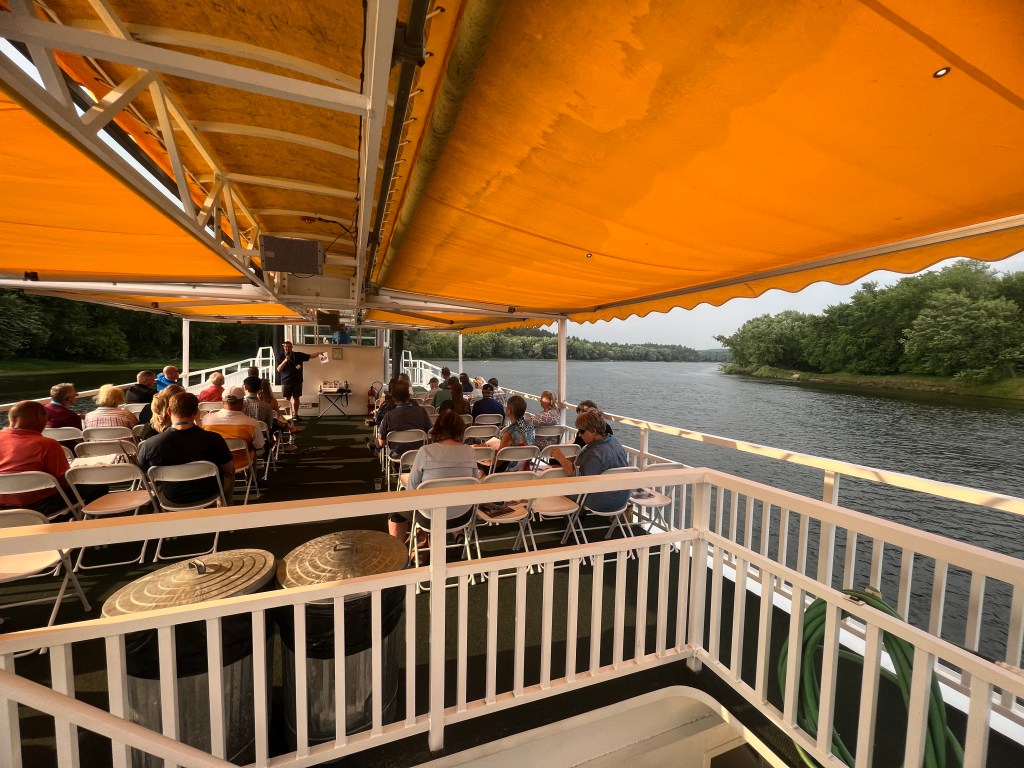
Fast forward another week. Now I’m on a paddleboat – the Taylors Falls Princess – in the middle of the St. Croix River with about a hundred people, slowly passing tall cliffs of basalt. The air is hot but the breeze is comfortably cool. Blue herons cross my line of view, their reflection whizzing across the sparkling water as they beeline for the protection of shady shores.
I’m officially at work for this one, helping run the St. Croix River Workshop on the Water for Local Leaders, a collaboration between state and local government partners to bring decision makers together to talk water, land use, and sustainable water management. I have just introduced our keynote speaker – Dr. Mae Davenport, a professor in the Department of Forest Resources at the University of Minnesota.
“I’ve had a strong connection with water ever since I was a little girl,’ she said, “But this is the first time I’ve ever gotten the chance to give a talk about water on a boat.”
Mae is a trained social scientist and one who is fascinated with mapping and collecting narratives about water and people. She argues that many of our water problems are actually more social in nature and that instead of just trying to focus on the practices that can help stop pollution, we need to build community capacity to protect and restore clean water.
“Everybody has a water story and connection. It’s so important to take the time listen to and understand those connections, because that helps strengthen relationships and motivates people to act. We spend so much time ‘managing water’ versus trying to understand how to engage and motivate the people we’re managing the water for.”
In 2019, Mae was part of a state-wide effort to capture Minnesota residents views on water values. Close to 1,500 Minnesotans responded to the survey:
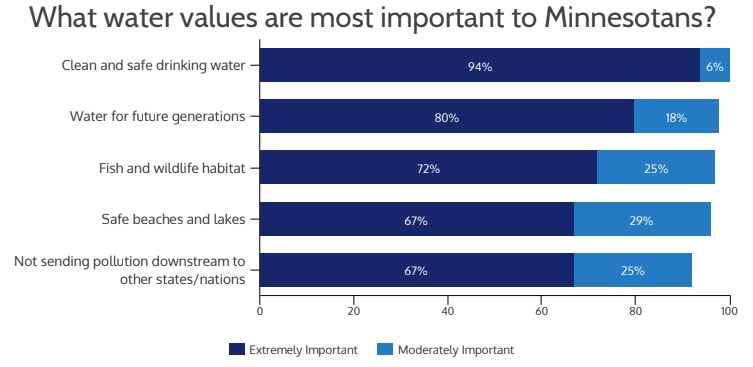
Unsurprisingly, clean and safe drinking water was at the top of the list. The next three pretty much summed up what was so impactful in my own recently captured water memories – seeing the next generation (my kids) safely enjoy clean lakes and rivers and local wildlife.
I was very intrigued to note that many Minnesotans placed a large importance on not sending polluted water downstream. As the state with the headwaters for the mighty Mississippi River, apparently we are well aware that we play an outsize role in trying to prevent pollution upstream.
Another interesting tidbit from the survey: A majority of Minnesotans (55%) believe residents in their community can work together to protect water, but fewer than half (41%) believe their community has the leadership it needs to protect water. Mae sees this as an opportunity.
“Let’s be less about managing water and exercising authority, and more about relationship building. That’s how to get us on a path of true change.”
Needless to say, surrounded by the beauty of the river around us, it was hard to argue her point. After the official program for the evening concluded, I thoroughly enjoyed hearing and sharing water stories with the other workshop participants as we floated along the river, with kids running along the shoreline and kayakers ducking into and out of small coves. The river set the stage, and we were just grateful to be there.
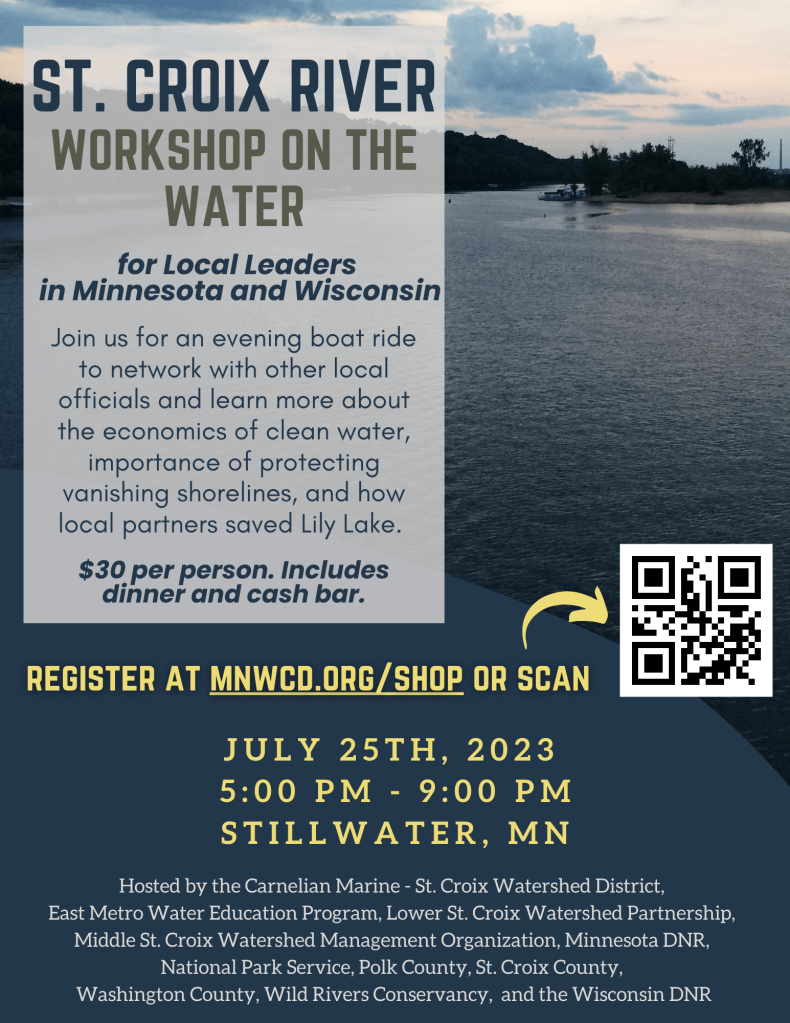
We have another opportunity next month to attend our Workshop on the Water – this time out of Stillwater! If you are a local decision maker for your community, we would love to have you. You can learn more and register at www.mnwcd.org/shop.

 knickpoints